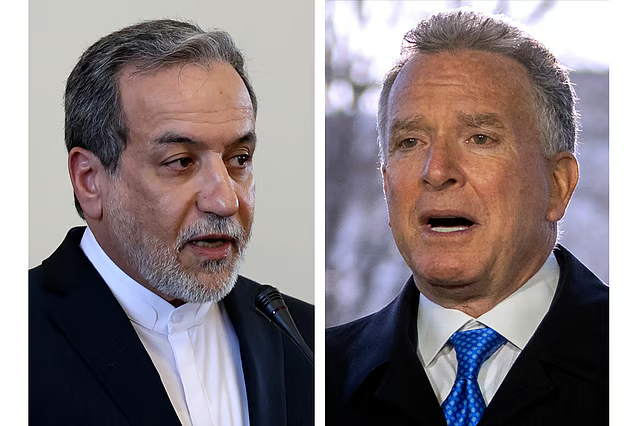


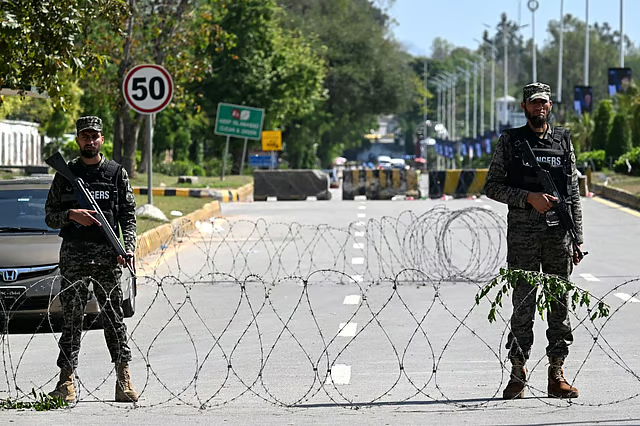
The United States and Iran are once again at a critical crossroads. After weeks of direct and proxy conflict, a fragile ceasefire and renewed diplomatic push have opened a narrow window to prevent a wider regional war. Yet beneath the headlines of negotiations lies a far more complicated reality: deep mistrust, conflicting objectives, and escalating regional tensions that threaten to derail peace at any moment.
Table of Contents
A fragile pause, not a resolution
The current ceasefire—brokered with international mediation—has temporarily halted hostilities, but it remains highly unstable. Both sides continue to accuse each other of violations, while military activity across the region has not fully ceased.
The truce is structured as a short-term pause followed by negotiations aimed at a long-term settlement, including reopening the strategically vital Strait of Hormuz and addressing Iran’s nuclear ambitions. However, analysts widely view this as a tactical pause rather than a genuine breakthrough.
In short: the war has stopped—for now—but the reasons for it have not.
The core disputes remain unchanged
At the heart of the talks are long-standing disagreements that have resisted resolution for decades:
- Nuclear program: The U.S. demands strict limits or full dismantlement, while Iran insists on its right to uranium enrichment.
- Sanctions vs. sovereignty: Tehran wants sanctions lifted and reparations, while Washington ties relief to major concessions.
- Regional influence: The U.S. seeks an end to Iran’s support for proxy groups; Iran views this as non-negotiable leverage.
Even the frameworks for peace differ sharply. Washington has proposed a detailed multi-point plan, while Iran has countered with its own version—reportedly with inconsistencies between drafts, adding further confusion to negotiations.
This isn’t a negotiation over details—it’s a clash of strategic visions.
Escalation risks are still high
Despite diplomatic efforts, the region remains on edge. Recent developments underline how quickly talks could collapse:
- Iranian strikes on Saudi infrastructure risk widening the conflict.
- Tensions involving Israel and Lebanon threaten to pull additional actors into the war.
- Disruptions in the Strait of Hormuz continue to endanger global energy supplies.
Each of these flashpoints operates independently—but together, they form a volatile chain reaction. One miscalculation could undo diplomacy overnight.
The nuclear question: the ultimate dealbreaker
The biggest obstacle remains Iran’s nuclear capabilities. While U.S. officials claim progress in limiting the program, experts warn that key elements—such as uranium stockpiles and technical expertise—may still be intact.
This creates a fundamental dilemma:
- The U.S. cannot accept a deal that allows Iran to move closer to nuclear weapons.
- Iran cannot accept a deal that strips it of what it sees as sovereign rights.
That gap is not just technical—it’s ideological.
A narrow path to peace
For talks to succeed, both sides will need to make politically difficult concessions:
- The U.S. may need to accept limited enrichment under strict monitoring.
- Iran may need to scale back regional activities and accept intrusive inspections.
History suggests this is possible—but only barely. Previous negotiations have shown moments of progress, often followed by breakdowns due to domestic politics, mistrust, or external events.
So, can war be avoided?
Realistically, yes—but the odds are not great.
There are three possible outcomes:
- Short-term deal, long-term tension – The most likely scenario: a temporary agreement that delays conflict without resolving core issues.
- Breakdown and renewed war – If talks fail or are undermined by regional escalation.
- Comprehensive agreement – The least likely, but most impactful outcome, requiring major compromises from both sides.
Final takeaway
These talks are not just another round of diplomacy—they are a stress test for whether decades of hostility can be contained in an increasingly unstable region.
Right now, the situation is balanced on a knife’s edge. One side wants security guarantees; the other wants sovereignty and relief. Both want leverage. Neither fully trusts the other.
And that’s exactly why this moment matters.
Because if diplomacy fails this time, the next phase likely won’t be negotiations—it’ll be escalation.