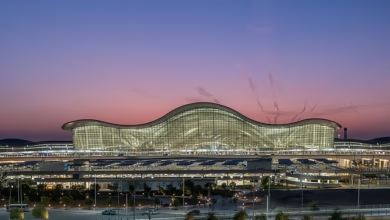


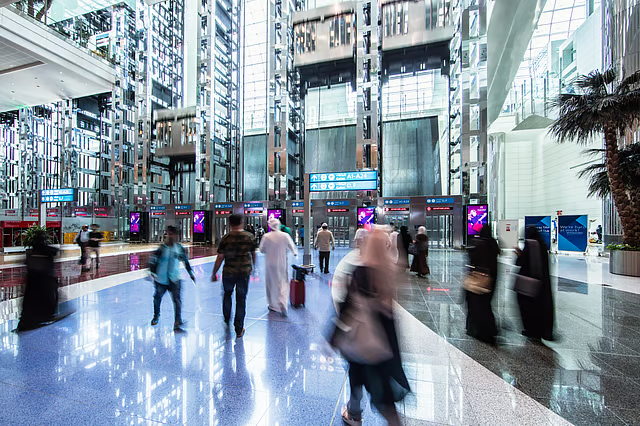
Six months into the US-Iran war, Gulf aviation is showing remarkable resilience. Airlines have restored many routes, passenger demand is recovering and major airports across the region are moving closer to their pre-conflict trajectories.
However, the recovery has not been equal across the region.
For UAE airlines, airports and travellers, the conflict has changed how carriers plan capacity, manage routes and assess future growth. While low-cost airlines have recovered relatively quickly, major full-service carriers continue to operate below their previous capacity levels.
The crisis has also highlighted the importance of flexible networks, alternative routes and strong contingency planning for Gulf aviation.
Table of Contents
Gulf Aviation Recovery Is Gathering Pace
The initial impact of the conflict was severe for regional air travel, particularly because Gulf hubs depend heavily on international transfer passengers.
Dubai, Abu Dhabi and Doha are among the world’s major aviation gateways, connecting passengers between Asia, Europe, Africa and the Americas.
According to aviation analysts cited by Gulf News, the recovery has been faster than initially expected.
Dubai is reportedly on course to approach its pre-conflict passenger trajectory, while Abu Dhabi and Doha have also rebuilt significant portions of their networks.
Transfer passengers, which represent a major part of Gulf hub traffic, were among the first groups affected when regional airspace disruptions occurred.
By the summer travel peak, connecting passengers had returned strongly, accounting for around half of Dubai’s traffic according to aviation analysis cited in the report.


UAE Airlines Are Recovering at Different Speeds
One of the most important developments in Gulf aviation is the difference between low-cost and full-service airlines.
Air Arabia and flydubai have reportedly recovered capacity to around 90% of their 2025 levels.
Their relatively strong recovery is partly linked to their business models.
Low-cost carriers generally focus heavily on point-to-point routes and regional travel. This means they can benefit quickly when domestic, regional and intra-Gulf travel demand returns.
Full-service network airlines face a different challenge.
Their business models depend heavily on international connecting passengers and long-haul networks. Consequently, disruptions to major air corridors can have a much larger impact.
According to aviation analysis cited by Gulf News, some major full-service carriers remain around 20–25% below their 2025 capacity levels.
Why Emirates Matters So Much to the UAE
The performance of Emirates is particularly important for the UAE aviation market because of the airline’s enormous scale.
Emirates operates one of the world’s largest long-haul networks and uses Dubai as its primary global hub.
When an airline of this size changes capacity, routes or schedules, the effects can extend beyond aviation into tourism, hospitality, airport services and the wider UAE economy.
The recovery of Emirates therefore remains an important indicator for the broader Gulf aviation market.
Although demand has returned, airlines must continue balancing passenger demand against operating costs, aircraft availability, insurance considerations and regional security risks.
For official information about flights and airport operations, travellers should check Dubai Airports and their airline before travelling.
Low-Cost Carriers Are Showing Greater Resilience
The faster recovery of low-cost airlines offers an important lesson from the crisis.
Carriers such as Air Arabia and flydubai have significant exposure to regional and point-to-point demand.
When passengers begin travelling again, short- and medium-haul regional markets can recover relatively quickly.
This allows low-cost carriers to restore capacity faster than airlines whose networks depend heavily on long-haul connections.
For travellers, this could mean more options for regional trips even while some long-haul services remain below earlier capacity levels.
Full-Service Airlines Face a Longer Recovery
The picture is more complicated for Gulf network carriers.
Full-service airlines have historically built their business models around connecting passengers through major hubs.
A disruption affecting regional airspace can therefore create a chain reaction.
An aircraft travelling between Asia and Europe, for example, may need to avoid affected airspace, increasing flight time, fuel consumption and operating costs.
Airlines may also need to adjust schedules, aircraft rotations and crew planning.
These changes can make restoring a large global network more complicated than simply adding flights back to a schedule.
What the Crisis Means for UAE Travellers
For passengers, the recovery means travel options are improving, but travellers should not assume that every route has returned to normal.
Passengers travelling through Gulf hubs may still encounter changes involving:
- Flight schedules
- Connecting routes
- Aircraft types
- Travel times
- Fares
- Transit arrangements
- Airport operating procedures
Travellers should therefore check their flight status shortly before departure and allow sufficient time for connections.
Airline schedules can change rapidly when regional security conditions shift.
Airfares Could Remain Under Pressure
The conflict has also created cost pressures for airlines.
Longer alternative routes can increase fuel consumption and aircraft operating time. At the same time, airlines must balance capacity with passenger demand.
If capacity remains below pre-conflict levels while demand stays strong, fares could remain elevated on certain routes.
However, the return of low-cost capacity may create more competitive pricing on regional routes.
This means travellers could see different fare trends depending on their destination, airline and travel period.
Gulf Aviation Is Becoming More Focused on Flexibility
Perhaps the biggest long-term lesson from the crisis is that Gulf airlines can no longer plan growth only around steadily increasing demand.
They also need to plan for disruption.
Airlines are increasingly required to consider:
- Alternative flight paths
- Flexible aircraft deployment
- Network diversification
- Contingency scheduling
- Security risks
- Fuel costs
- Insurance expenses
- Passenger demand changes
The ability to quickly restore schedules could become a competitive advantage for airlines operating in geopolitically sensitive regions.
Airports Continue Investing Despite the Crisis
The conflict has not stopped major Gulf airport development plans.
Dubai, Abu Dhabi and Doha remain strategically important international aviation hubs.
Their geographic locations make them particularly valuable for connecting passengers travelling between major global markets.
The continued investment in airport infrastructure also reflects expectations that long-term international travel demand will continue growing.
For Dubai in particular, aviation is closely connected to tourism, business travel and the wider economy.
You can learn more about Dubai’s airport infrastructure and passenger services through Dubai Airports’ official website.
What This Means for Gulf Aviation’s Future
The current recovery suggests that Gulf aviation remains fundamentally strong despite the unprecedented disruption caused by the conflict.
Passenger demand has returned faster than many expected, regional airlines are rebuilding schedules and major airports remain central to global connectivity.
But the crisis has also exposed vulnerabilities.
The biggest Gulf carriers cannot completely separate their operations from geopolitical developments affecting the region.
That means future expansion is likely to involve more careful risk assessment.
Airlines may prioritize flexible capacity, diversified routes and stronger contingency planning rather than simply pursuing maximum network growth.
Gulf Aviation Could End 2026 on a Stronger Note
Six months into the US-Iran war, the outlook for Gulf aviation is considerably more positive than it was during the initial disruption.
Low-cost carriers have recovered strongly, passenger traffic is returning and major Gulf hubs are rebuilding their international networks.
However, full-service carriers continue to face capacity challenges, while operating costs and geopolitical uncertainty remain concerns.
For UAE travellers, the biggest takeaway is that aviation is recovering—but the region’s airlines are operating in a more cautious environment.
The crisis may ultimately change not only how airlines fly but also how they plan their next decade of growth.
Key Takeaways
- Gulf aviation is recovering faster than initially expected.
- Dubai, Abu Dhabi and Doha are rebuilding international connectivity.
- Air Arabia and flydubai have reportedly recovered around 90% of their 2025 capacity.
- Some full-service carriers remain 20–25% below previous capacity.
- Emirates’ performance has a major impact on the UAE aviation market.
- Travellers should continue checking schedules before departure.
- Airspace risks can affect routes, flight times and operating costs.
- Future airline growth is likely to place greater emphasis on flexibility and contingency planning.