


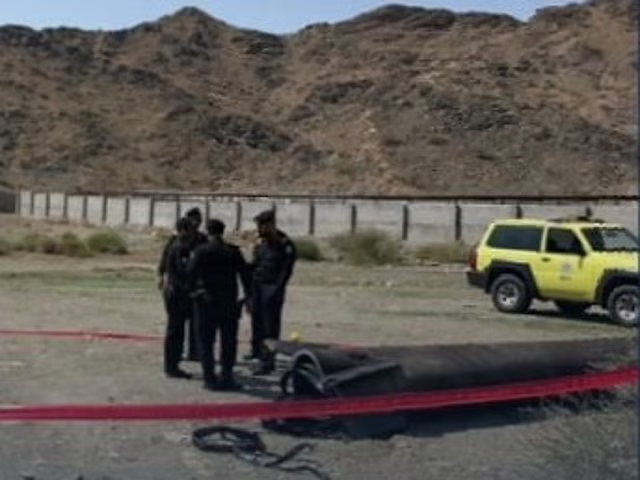
Saudi Arabia intercepts Houthi missiles targeting the Mecca and Medina regions, with debris reported in several locations across western Saudi Arabia. The incident on October 24, 2026, prompted a response from Saudi Civil Defence teams as authorities followed established procedures for handling falling missile debris.
According to the Saudi Press Agency (SPA), two ballistic missiles launched by Yemen’s Houthi movement toward the Mecca and Medina regions were intercepted. Parts of the intercepted missiles and debris fell in Wadi Al-Mughammas in Mecca, Al-Nuzha neighbourhood in Jeddah, Wadi Jalil in Taif, and Masturah in Rabigh governorate.
The incident comes amid escalating regional tensions and renewed missile and drone activity involving Saudi Arabia and Yemen’s Houthi movement. However, the precise intended targets remain disputed: the Houthis denied targeting the two holy cities and said their operations focused on other Saudi sites.
Saudi authorities confirmed that emergency teams responded to reports of falling debris and that established response procedures were implemented. The initial announcement did not provide detailed information about casualties or property damage.
Table of Contents
Saudi Arabia Intercepts Houthi Missiles: What Happened?
Saudi Arabia reported the interception of two ballistic missiles launched by Yemen’s Houthi movement toward the Mecca and Medina regions on Saturday, October 24, 2026.
The Saudi Civil Defence announcement said emergency teams in the two regions responded to reports of falling debris following the interceptions. Fragments were reported at several locations across western Saudi Arabia, including areas in Mecca, Jeddah, Taif, and Rabigh.
The Saudi Press Agency published the official announcement, confirming that the established procedures for handling such incidents had been carried out.
Read the official Saudi Press Agency report for the original announcement.
The incident highlights the security challenges associated with ballistic missiles and other aerial threats. Even when a missile is intercepted, debris can travel away from the interception area and fall onto roads, open land, neighbourhoods, or other locations.
For this reason, an interception does not automatically mean that all risks have disappeared. Emergency services may still need to assess the affected locations, secure hazardous areas, and determine whether any additional assistance is required.
The initial announcement confirmed the response to falling debris but did not provide a complete assessment of damage or injuries.
It is therefore important to distinguish between what authorities confirmed and what remains unknown. The interception and debris reports were officially announced, but further conclusions about damage, casualties, or the precise circumstances of the launches require additional verified information.

Where Did Missile Debris Fall?
Saudi Civil Defence identified four locations where debris from the interceptions was reported. These locations span several areas of western Saudi Arabia.
1. Wadi Al-Mughammas in Mecca
Parts of the intercepted missiles fell in Wadi Al-Mughammas in Mecca, according to the Saudi Civil Defence announcement.
The report placed this location within the holy city of Mecca, one of the most significant religious destinations in the world. Any security incident in the wider region attracts attention because of the city’s importance to residents, visitors, and Muslim pilgrims.
However, the debris report alone does not establish that the Grand Mosque or other major religious sites were struck.
2. Al-Nuzha Neighbourhood in Jeddah
Debris was also reported in the Al-Nuzha neighbourhood of Jeddah.
Jeddah is a major Saudi city on the Red Sea coast and an important commercial, transport, and travel centre. Reports of falling debris in a populated urban area can require careful assessment to determine whether buildings, roads, vehicles, or public infrastructure have been affected.
The initial announcement did not provide a detailed account of damage in Al-Nuzha.
3. Wadi Jalil in Taif
Another reported debris location was Wadi Jalil in Taif governorate.
Taif is situated in western Saudi Arabia and is connected to the wider Mecca region. The presence of interception debris in the area underlined the geographical spread of the reports associated with the two missiles.
Authorities did not publish detailed measurements of the debris field in the initial statement.
4. Masturah in Rabigh Governorate
The fourth location was Masturah in Rabigh governorate.
Rabigh lies along Saudi Arabia’s Red Sea coast, north of Jeddah. The debris report extended the incident’s reported geographical footprint beyond Mecca itself.
Together, these four locations demonstrate why authorities need to assess debris reports across multiple areas following an aerial interception.
The reports should not be interpreted as confirmation that every location suffered significant damage. They identify where debris was reported, while the full extent of any consequences was not established in the initial announcement.
How Saudi Civil Defence Responded
Saudi Civil Defence teams in the Mecca and Medina regions responded to reports of falling debris following the interceptions.
The official spokesperson confirmed that established procedures for such incidents had been implemented. The announcement did not describe every operational step taken by emergency responders.
In general, an emergency response to suspected missile debris can involve identifying the affected area, assessing immediate hazards, keeping people away from dangerous fragments, and coordinating with the relevant authorities.
Debris may contain sharp metal, unstable components, or other potentially hazardous materials. Some fragments may also be located in places that are difficult to access or inspect safely.
Residents should therefore avoid approaching, touching, or attempting to move unidentified debris following a missile or drone interception. Reporting suspicious objects to the appropriate authorities is safer than attempting to examine them independently.
Emergency teams may also need to determine whether roads or public spaces require temporary restrictions while an assessment is underway.
The Saudi statement confirmed that the established procedures had been followed, but it did not provide a detailed breakdown of the response, the number of personnel deployed, or the time needed to inspect every reported location.
Further official updates would be required to establish whether additional safety measures were introduced or whether any locations remained restricted after the initial response.
Why Mecca and Medina Are Strategically Important
Mecca and Medina hold exceptional religious significance for Muslims around the world.
Mecca is home to the Grand Mosque and the Kaaba, which Muslims face during their daily prayers. Medina is home to the Prophet’s Mosque and is another major destination for religious visitors.
Millions of Muslims travel to Saudi Arabia each year for Hajj, Umrah, and other religious visits. As a result, security developments affecting the wider regions can attract international attention, including from prospective pilgrims and their families.
However, the report of intercepted missiles directed toward the Mecca and Medina regions should be distinguished from a confirmed strike on either city’s principal religious sites.
The Saudi announcement described falling debris in specific locations. It did not say that the Grand Mosque, the Prophet’s Mosque, or other major holy sites had been struck.
This distinction is important when reporting security incidents involving religious landmarks. Accurate language helps readers understand what authorities have actually confirmed without creating unnecessary alarm.
Saudi Arabia’s role as a destination for religious tourism also means that reliable public information is particularly important during periods of regional tension.
Travellers should rely on official Saudi announcements, airline updates, and guidance from relevant travel authorities rather than unverified social media posts.
For more regional travel context, readers can also explore DigiSmarties’ coverage of Dubai tourism recovery in 2026.
Houthis Dispute Claims About the Intended Targets
Although Saudi authorities reported that two ballistic missiles had been launched toward the Mecca and Medina regions, the Houthis disputed the claim that the holy cities were the intended targets.
Reuters reported that the Houthi movement said its operations focused on Saudi oil facilities, airports, and military installations. The group denied targeting Mecca and Medina.
This disagreement is a significant part of the story because the intended targets could not be independently established from the debris reports alone.
The Saudi announcement described the direction of the missiles and the locations where debris fell after interception. The Houthi account offered a different explanation of the operations.
These statements should be attributed to their respective sources rather than presented as independently verified facts.
The distinction between a missile’s intended target, its reported flight path, the interception location, and the eventual debris locations is important in military reporting.
Debris falling in a particular city or region does not, by itself, prove that the location was the original intended target.
Similarly, a claim by an armed group about its intended targets does not independently establish that every claimed target was attacked or that the operation unfolded as described.
Readers should therefore follow subsequent statements from Saudi authorities, the Houthis, and credible independent news organisations for further clarification.
The available reports establish that Saudi Arabia announced the interception of two ballistic missiles and that debris fell at several locations. They also establish that the Houthis disputed the allegation concerning the two holy cities.
The precise targeting circumstances remain a separate question.
Rising Regional Security Concerns
The missile incident occurred during a period of heightened regional tensions involving Saudi Arabia and Yemen’s Houthi movement.
Missile and drone activity can create risks for civilians, transport networks, energy infrastructure, and commercial operations. Even where aerial threats are intercepted, authorities may need to investigate debris reports and assess possible disruption.
Saudi Arabia has important transport connections, major airports, energy facilities, and commercial infrastructure. Security developments can therefore have implications beyond the immediate locations where debris is found.
Airlines may review operational risks, airports may issue instructions, and local authorities may communicate additional safety measures when security conditions change. However, any specific disruption should be confirmed through official announcements rather than assumed from the interception alone.
The broader situation also requires careful reporting because different parties may provide conflicting accounts of targets, damage, and military outcomes.
Independent verification can take time, especially when information comes from active conflict zones or when access to affected areas is limited.
For readers following the wider conflict, Reuters’ reporting provides additional context about the regional developments and the competing claims surrounding the October 24 incident.
Read Reuters’ coverage of the regional missile and drone developments.
The wider security environment may continue to evolve after the initial announcement. New information should therefore be checked against the date and time of the relevant official statement.
What the Incident Means for Residents and Travellers
The reports of falling debris may raise concerns among residents, visitors, and people planning to travel to western Saudi Arabia.
At the time of the initial announcement, Saudi Civil Defence confirmed its response and implementation of established procedures. The statement did not provide a comprehensive account of casualties, property damage, or any wider travel restrictions.
Residents should follow instructions issued by local authorities and avoid areas identified as potentially hazardous.
If unidentified debris is discovered, people should not touch, photograph from close range, or attempt to move it. They should maintain a safe distance and contact the appropriate emergency services.
Travellers planning to visit Mecca, Medina, Jeddah, Taif, or nearby areas should check their airline’s latest operational notices and consult official Saudi information before departure.
Passengers should not assume that all flights have been cancelled or that every destination is inaccessible simply because a missile interception has been reported.
Likewise, travellers should not assume that there can be no disruption. Conditions may change, and airlines or authorities may issue new guidance if the security situation requires it.
Pilgrims travelling through tour operators should maintain contact with their organisers for confirmed transport arrangements and any updated instructions.
International visitors should also monitor relevant embassy or consular advisories when appropriate.
Reliable information is especially important during fast-moving events. Social media images can be old, incorrectly labelled, or taken from unrelated incidents. Checking the original publication date and the source can help reduce the risk of sharing misleading information.
Missile Interception and Falling Debris: What to Know
An interception occurs when defensive systems engage an incoming aerial threat. The outcome may prevent a missile from reaching its intended destination, but fragments from the intercepted object or the interception itself can still fall to the ground.
The location of the debris may depend on the missile’s trajectory, the interception point, its remaining momentum, and other physical factors.
This is why debris can be reported in areas separate from where the interception was first detected.
The presence of debris does not necessarily mean that an incoming missile successfully reached its intended target. In this case, Saudi authorities described the debris as resulting from the interception of two ballistic missiles.
A full technical account would require additional verified information about the missiles, interception systems, flight paths, and the circumstances of the incident.
The initial public announcement did not provide those technical details, so it would be inappropriate to draw conclusions about the performance of particular defence systems or the exact locations of the interceptions.
From a public safety perspective, the most important message is straightforward: people should follow official instructions, keep away from unidentified fragments, and report potentially dangerous objects to the relevant authorities.
Final Thoughts
The October 24 incident in which Saudi Arabia reported intercepting two Houthi ballistic missiles has drawn attention to the security situation across western Saudi Arabia. Civil Defence confirmed that debris fell in parts of Mecca, Jeddah, Taif, and Rabigh and that established response procedures were implemented.
The reported locations are important, but the available information does not establish that major holy sites were struck or provide a complete assessment of damage and casualties. The Houthis also disputed Saudi Arabia’s account of the missiles’ intended targets.
For residents and travellers, the priority is to follow official safety guidance and monitor reliable updates. For readers following the wider conflict, the incident is another reminder that regional security developments can change quickly and that careful verification is essential when reporting military events.


